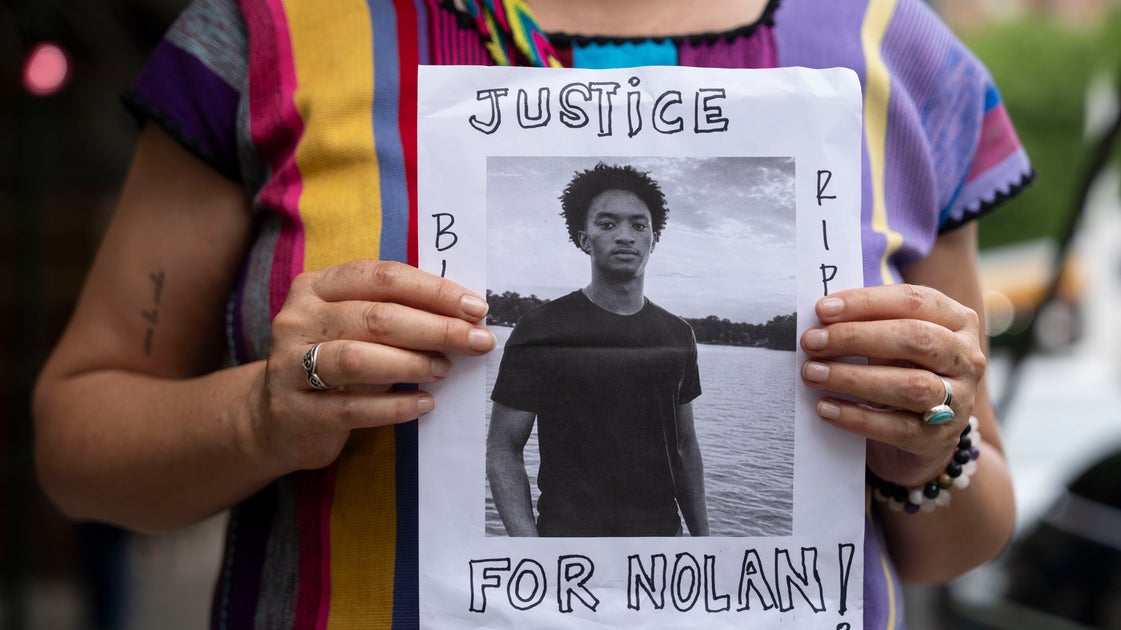
No Murder Charge, But Nolan Wells’ Death Still Leaves Too Much Unanswered
Summary
A Mississippi grand jury found no evidence of criminal conduct in the death of 18-year-old Nolan Wells, who disappeared on Horn Island over the Fourth of July and was found dead two days later. His family's attorney, Ben Crump, says the case still leaves more questions than answers.
A 23-member Jackson County grand jury unanimously returned a “no true bill” on Sept. 22 after reviewing 132 subpoenas, hearing from 43 witnesses and inviting seven people to testify in the death of 18-year-old Nolan Wells.
District Attorney Angel Myers McIlrath said investigators found no evidence that Wells’ disappearance and death resulted from criminal conduct or were racially motivated. The grand jury ultimately declined to recommend charges against anyone who was with him on Horn Island.
HuffPost Black Voices responded much more forcefully, framing the decision as another example of justice being denied to Black Americans and placing Wells’ death alongside cases including Tamla Horsford and Trayvon Martin.
It is easy to understand why Nolan’s story produces that reaction. Black families have generations of reasons to be skeptical when a young Black person dies under unclear circumstances and authorities say no crime can be proven.
But Nolan’s case is also more complicated than the familiar story that framing suggests.
The available evidence does not establish that Nolan Wells was murdered. That does not make what happened around him neutral.
An 18-year-old Black man went to a remote Mississippi barrier island with people he trusted and became separated from them. They returned without him. His phone made it back before he did.
For many Black families, that is not a small detail.
We are often taught some version of the same rule: if we arrive together, we leave together — particularly when we are entering spaces where being the only Black person can already make isolation more dangerous.
That ethic is not paranoia. It is a form of communal care shaped by generations of understanding that our safety cannot always be assumed.
Nolan’s death may not prove murder. It does leave a harder question about responsibility: when did concern for his safety become optional?
And that responsibility did not end with the people who left Horn Island. It also extends to the institutions that were supposed to explain what happened afterward.
We cannot prove that a white teenager in Nolan’s position would have produced a different grand jury outcome. But Black families have historical reason to question whether their children’s disappearances, unexplained deaths and unanswered injuries receive the same urgency, persistence and benefit of the doubt. That is part of what makes this case painful even without proof of murder.
Nolan’s family had to push for an independent autopsy while both examinations still left his cause and manner of death undetermined. So the racial question is not only whether someone intentionally harmed him because he was Black. It is also whether, once a Black 18-year-old did not come home, every unanswered piece of his death was treated with the same seriousness his family had a right to expect.
What the autopsies still cannot answer
The grand jury report pointed to evidence consistent with drowning.
It described bruising on the back of Wells’ head as a nonfatal injury and cited testimony that he had slipped from a boat earlier in the day. The witness could not say whether Nolan struck his head during that fall and testified that he continued socializing afterward.
The report also said the position, condition and location of Nolan’s body were consistent with drowning.
But neither the state’s chief medical examiner nor the forensic pathologist retained by Nolan’s family has been able to determine precisely how he died.
Both listed his cause and manner of death as undetermined.
The family’s independent examination identified recent blunt-force injuries to the back of Nolan’s head and back. Attorney Ben Crump has repeatedly argued that those injuries remain unexplained and that the uncertainty surrounding Nolan’s death deserves further investigation.
Recent reporting from the Associated Press confirms the central tension in the case: the grand jury found no evidence of criminal conduct, while the medical evidence still has not produced a definitive cause of death. The family continues to dispute the drowning theory and has called for additional investigation.
That distinction matters.
An unexplained injury is not proof that someone attacked Nolan. An undetermined cause of death is not proof of homicide.
It is also not an answer.
The responsibility did not begin with the investigation
Much of the public debate has focused on whether Mississippi investigators treated Nolan’s death seriously enough and whether race influenced the case.
Those are legitimate questions.
But the question of care began before police, prosecutors or medical examiners became involved.
Nolan went to Horn Island with other people.
At some point, he was no longer with them.
They eventually left.
He did not.
One account presented to investigators was that Nolan chose to remain behind as others departed because of problems with the boat. Whatever happened in those final hours, the grand jury did not find evidence that the people with him committed a crime.
Criminal liability, however, is not the only measure by which people understand responsibility.
For Black families, “we came together, we leave together” can be an informal safety system. Parents teach it. Friends repeat it before nights out. People check who has a ride, who has their phone and whether everyone made it home.
It comes from experience.
Black people have historically had fewer reasons to assume that an unfamiliar environment, a stranger or an institution will automatically protect us if something goes wrong. Community care develops partly in response to that uncertainty.
That does not mean every Black person follows the rule or that every white person does not.
It means Nolan’s story touches a cultural nerve deeper than the question of whether prosecutors can prove a crime.
A Black mother sent her 18-year-old son somewhere with people he knew.
Those people came back.
Her son did not.
That is enough to understand why “no criminal conduct” cannot resolve every question his family is carrying.
What justice can mean when no crime can be proven
Civil rights attorney Ben Crump rejected the district attorney’s characterization of the case after the grand jury decision, saying the report left the family with “more questions than answers.”
Nolan’s mother, Christine Wells-Wonsley, expressed something even more fundamental after the decision.
“Last night was a reminder that our son's life does not matter to those who hold positions that are supposed to serve and protect the public,” she said, according to HuffPost. “Nolan is loved. He is cherished. He is honored. And he did not deserve to have his life taken away so suddenly.”
There may never be evidence showing that another person intentionally caused Nolan Wells’ death.
Acknowledging that possibility is not the same as saying everything surrounding his death was handled well.
The grand jury answered the question placed in front of it: whether the evidence supported criminal charges.
Nolan’s family is left with a different one.
How did their son go somewhere with people he trusted and end up dead there without them?
Until that question has an answer, the absence of an indictment can close a criminal proceeding.
It cannot close a mother’s need to understand how her son was left behind.
TBI context
Related Articles
Directly connected reporting and highlights from TBI, including work kept in the archive.

Activism · Jul 30
The Fight for Nolan Wells: A Grieving Family's Call to Action Amid a Coordinated PR Spin
Original TBI analytical feature. Sources: USA Today, AP News, The Grio, CNN, The Guardian, Clarion Ledger, Mississippi Today, PBS NewsHour, ABC News, NewsNation.

Community · Jun 22
R.E.N.T Party: Boston Revives Historic Tradition to Support Black Businesses on June 26th
Eventbrite, The Hustle List (Past Event Context)

Activism · Sep 12
The 50-Year Playbook: From the War on Drugs to the War on Trans and Immigrant Lives
The Sentencing Project, Drug Policy Alliance, Prison Policy Initiative, ACLU of Idaho, Migration Policy Institute, and Congressional Black Caucus Foundation

Activism · Aug 18
Don't Go There, Gurl - A View of The Updated Trans Risk Assessment Map
Originally reported by Erin In The Morning